Are You Overpaying Thousands in Taxes Because of Your Business Structure?

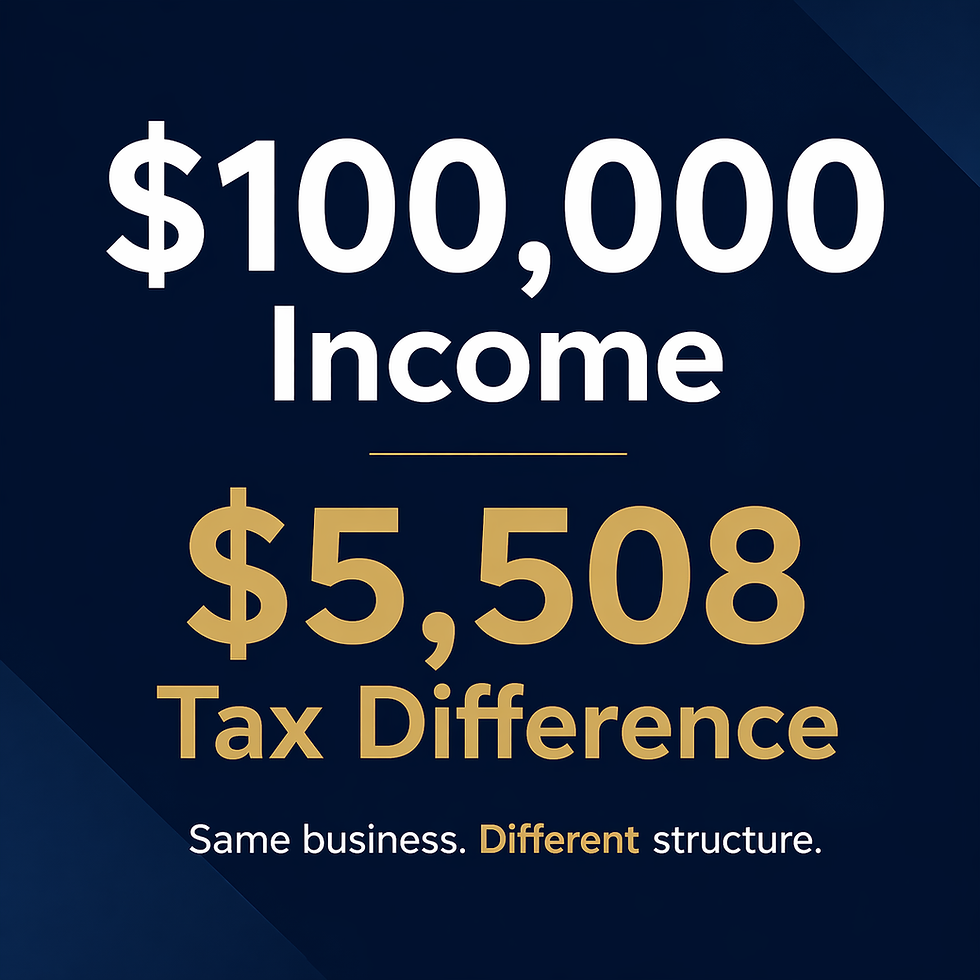
Most business owners don’t realize how much their entity structure impacts their total tax liability.
I see it all the time—profitable businesses operating as sole proprietors when an S-Corporation election could materially reduce the amount of income subject to FICA (self-employment) taxes.
The difference isn’t complicated, but the impact can be significant.
Here’s a Simple Example
Let’s assume:
$100,000 of net business income
Flat 20% income tax (for illustration purposes)
Sole Proprietor
FICA (S/E Tax) applies to the full $100,000
Income tax applies to nearly all of it
👉 Total tax: $33,770
S-Corporation
FICA applies only to salary (not total profit)
Remaining income is not subject to FICA
Income tax still applies to all income
👉 Total tax: $28,262
What’s the Difference?
👉 TAX SAVINGS: $5,508

Is an S-Corporation Always the Right Answer?
Not necessarily.
The S-Corporation can create meaningful tax savings—but only when it’s applied correctly and in the right situation.
There are trade-offs, including:
Payroll requirements
Reasonable compensation rules
Additional administrative costs
State-level considerations
Loss of fringe benefits for health insurance, group term life insurance, Health reimbursement arrangements (HRAs)
In some cases, the added complexity outweighs the benefit.
The goal isn’t to choose the most “popular” structure—it’s to choose the one that makes sense based on your numbers.
Why This Happens
The IRS treats these structures differently:
A sole proprietor pays FICA tax on all net income
An S-Corporation allows you to split income between:
Salary (subject to FICA)
Remaining profit (not subject to FICA)
You still pay income tax on everything.
The only thing that changes is:
how much income gets hit with that 15.3% FICA tax
Where Most People Get It Wrong
This isn’t about “avoiding taxes” or applying a one-size-fits-all strategy.
It’s about:
Structuring income correctly
Paying reasonable compensation
Understanding how the rules actually work
The IRS requires S-Corp owners to pay themselves a reasonable salary, based on facts and circumstances such as role, responsibilities, and industry standards.
When This Starts to Matter
If your business is:
Consistently profitable
Generating meaningful net income
Beyond the startup phase
Then entity structure becomes a real planning tool—not just a filing choice.
The Bottom Line
Most business owners don’t revisit their entity structure after they get started.
That’s where unnecessary tax cost shows up.
If your business is making money, your structure should be intentional—not default.
Next Step
If your business is generating consistent profit, it’s worth taking a closer look at how your income is being structured.
Most situations aren’t this simple
What else can you tell me about how your business is currently structured?


Comments